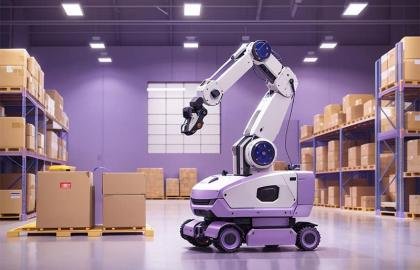
In the world of logistics, security, and healthcare, the lights never go out. Businesses that operate 24/7 need automation that can keep up. A standard robot vacuum might run for 90 minutes and then sleep for 4 hours, but that doesn't fly in a busy warehouse.
Designing for continuous operation requires a completely different approach to power management and durability.
The biggest hurdle to 24/7 operation is the battery. There are three main strategies to solve this:
Instead of running the battery from 100% to 0%, the robot charges whenever it has a free moment. If it has a 5-minute wait between tasks, it docks. This keeps the battery in a "sweet spot" and ensures the robot is always ready for the next job.
If you need 5 robots working at all times, you might buy 7. A cloud management system ensures that as soon as Robot A's battery dips below 20%, Robot B launches from the dock to replace it seamlessly. This is standard in Amazon-style fulfillment centers.
For some applications, charging is too slow. Robots designed for heavy duty use often feature hot-swappable batteries. A human operator (or an automated station) pulls out the depleted pack and slides in a fresh one, getting the robot back to work in 60 seconds.
A consumer robot is designed to run maybe 1 hour a day. A commercial robot runs 20 hours a day. That is a 20x difference in wear and tear.
The smartest continuous robots don't wait to break. They use IoT sensors to monitor their own health.
If a motor starts vibrating slightly more than usual, or a battery is heating up faster than it should, the robot alerts the fleet manager: "I need service in the next 48 hours." This prevents catastrophic failures during peak operating times.
Scenario: A large data center requires security patrols every hour, 24/7/365.
The Solution: They deployed a pair of autonomous patrol bots. The system is programmed so that Bot 1 patrols for 4 hours while Bot 2 charges. They swap shifts automatically.
The Result: The facility has achieved 99.8% uptime on patrols for over two years, with the only downtime being scheduled maintenance.
Continuous operation isn't just about a bigger battery; it's about a smarter system. By combining robust hardware with intelligent fleet management, robots can truly become the workforce that never sleeps.
Keep your business running. Explore 24/7 industrial solutions at Robots.shop.


The era of single-purpose robots (like the vacuum that only vacuums) is ending. The future belongs...
The open-plan office is evolving into a collaborative space for humans and machines. This article discusses...
For a robot to be truly autonomous, it cannot be stopped by a closed door or...





Cookie preferences